The Bathhouses Zurich Kept
Zurich’s oldest public baths are timber boxes set into the Limmat, the Schanzengraben and the lake. They still work on nineteenth-century lines: separate spaces, plain rules and water just beyond the wall.
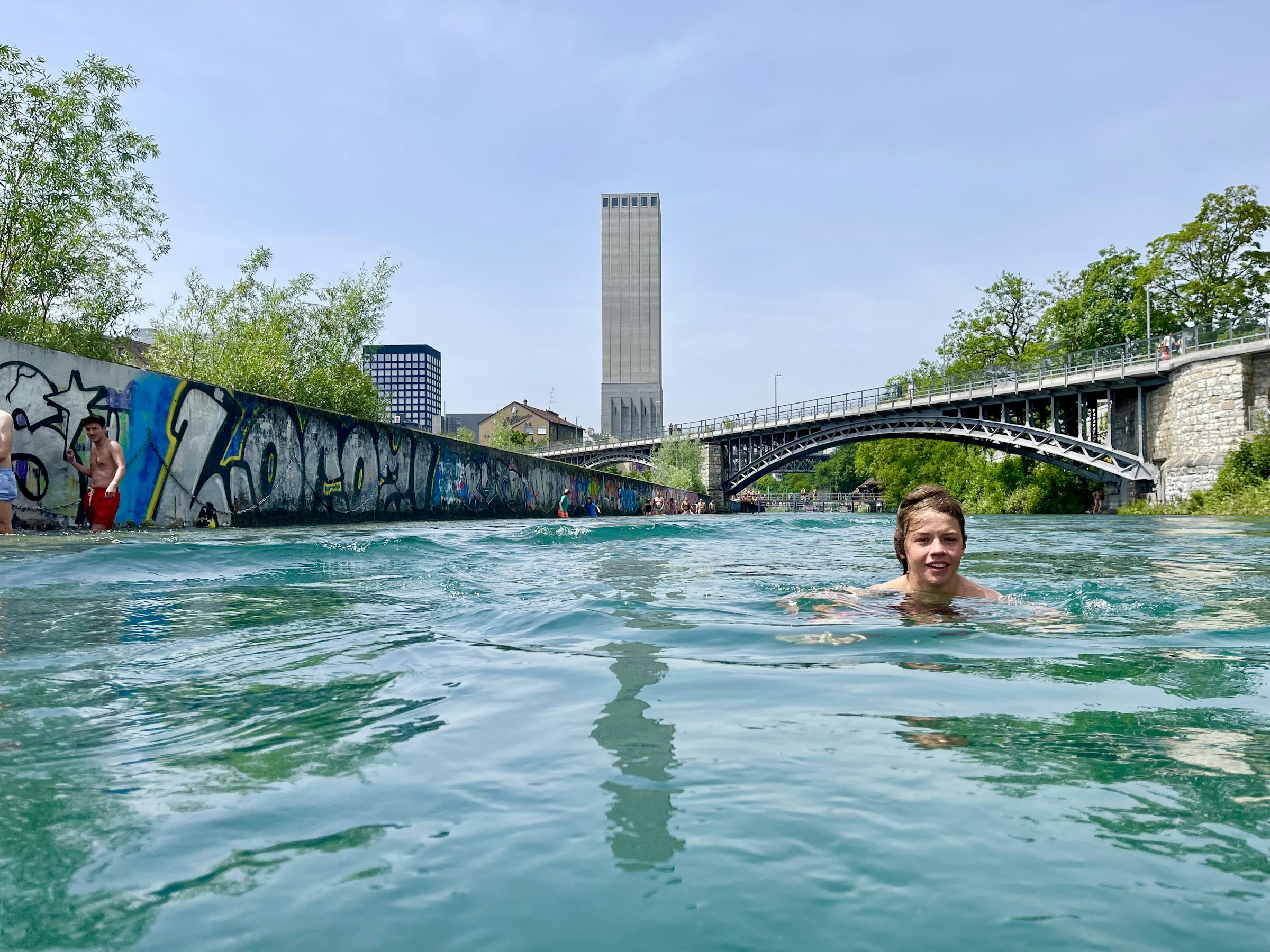
Zurich did not take to the water easily. The city’s heritage office, in its 2001 inventory of municipal baths, cites a council ban soon after the Reformation of 1525 on jumping into the Limmat from water wheels, and an eighteenth century in which open bathing was thought vulgar and even forbidden. In 1837, after a petition with many signatures, the city council built a bathhouse for women near the Bauschänzli, so that they would no longer bathe at night in the public fountains.
The type that followed was the Kastenbad, or box bath. The inventory defines it as an enclosure closed at the sides and underneath by an adjustable timber grid, standing on floats or piles in the water and reached from the shore by a walkway. It gave bathers cleaner water away from the bank, and the inventory places it in the 1850s.
Schanzengraben
The oldest survivor is the Männerbad Schanzengraben, built in 1863 and 1864 on Badweg in the old fortification moat. The inventory calls it the oldest bathing establishment in Zurich: a simple timber structure spanning the Schanzengraben, half-timbered along the footpath, resting partly on the bank and partly on piles. The city says it is privately run, free, and for men only during the day. In the evening it becomes a bar open to everyone.
Stadthausquai
The Frauenbad Stadthausquai sits in the Limmat a few steps below the Bauschänzli, joined to the quay by a narrow walkway. The heritage inventory names the architect, Arnold Geiser, and dates it to 1887; the sports department marked its 125th year in 2013. It first floated on steel caissons and is now anchored on piles. The inventory singles out the corner pavilions with their gently curved pagoda roofs, and records that the river-side cabins went in 1947. The sports department lists a 33 by 7 metre swimming pool, a 31 by 10 metre pool for non-swimmers and a small library. By day it is for women only. In the evening it, too, is a bar for all.
Utoquai and Enge
Seebad Utoquai was built in 1890 to a design by William Henri Martin, replacing an older bath in Riesbach. The sports department describes four closed compartments for women, girls, men and boys, each with a pool open to the lake, roof terraces added in 1908 for sunbathing, and the ornate domed towers removed in 1942. Today the city lists three rafts and separate sun terraces for women and men, and it admits to the water only people who can swim without aids.
Seebad Enge is the young one. The inventory records that a men’s bath of 1886 and a women’s bath of 1887 in Enge were replaced in 1959 and 1960 by a modern double bath. Its architect was Robert Landolt, and the floating structure is modelled on the timber box baths. The city says it is operated by Tonttu GmbH and keeps a women’s area beside swimming lanes in the lake.
The house rules
The sports department’s rules for the baths it runs are brief. Photography and filming are not permitted, including of one’s own children. River and lake baths fly signal flags: yellow for normal operation with supervision, red when swimming is not allowed. Prams stay outside Utoquai and the Frauenbad. The privacy the box baths were built to give is still, in its own way, enforced.