Zurich, Read Along the Water
A Roman bridge, a hilltop fort and a lakefront built in the 1880s explain how the old town sits. In the west, the industrial district has been converted in stages.
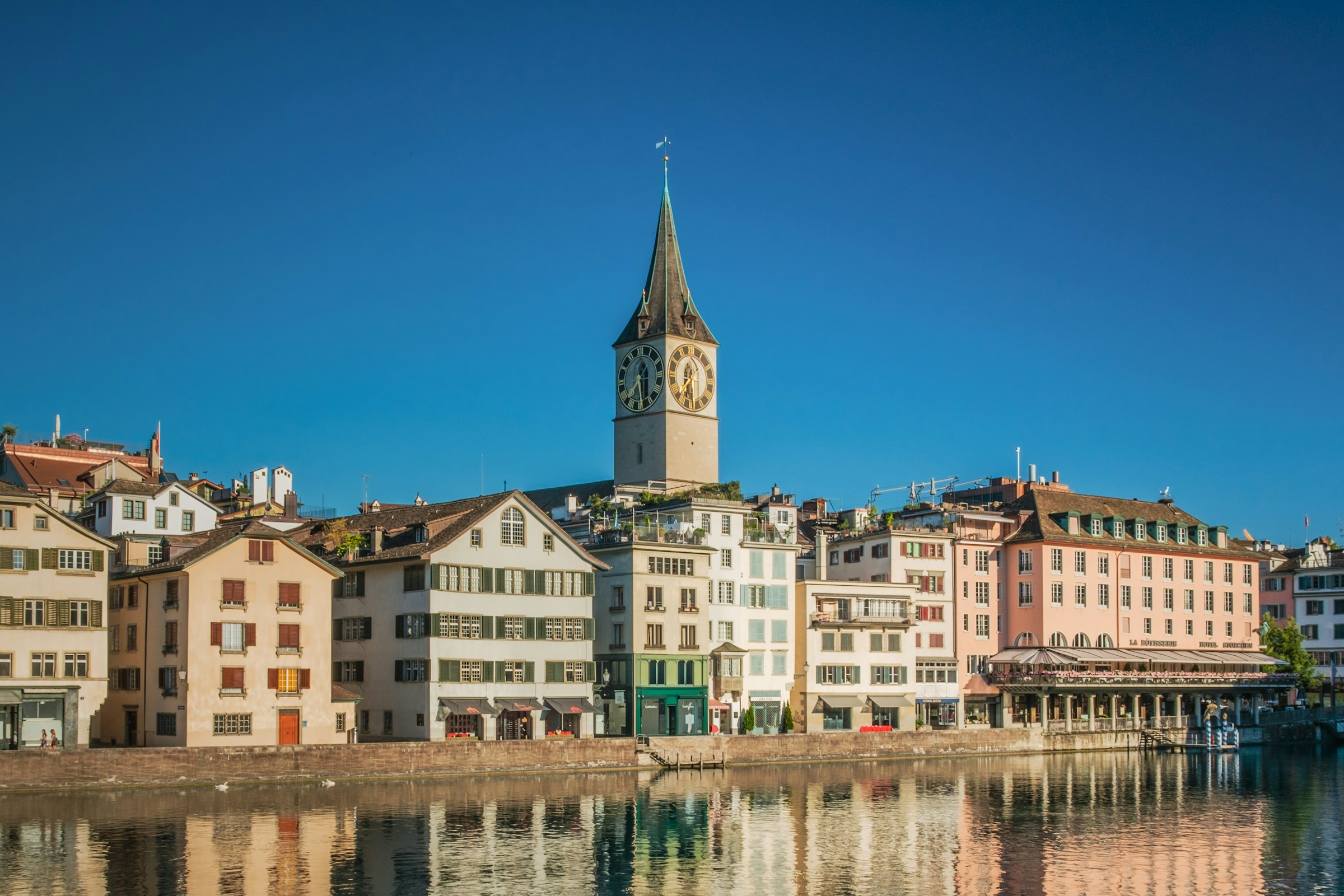
Zurich is easiest to read along its water. The Limmat leaves the lake at the edge of the centre and runs north through the old town, and much of what the city has chosen to keep, or to rebuild, stands within sight of the river or the shore.
A town on two banks
In the Roman period the settlement was called Turicum. From the middle of the first century AD, the canton’s archaeologists write, it spread towards the Limmat, and a few decades later buildings stood on the far bank as well, reached by a bridge. The west bank rises to Lindenhof, where a fort with towers and battlements was built around 300 AD. The city’s archaeologists trace what followed: a Carolingian palace in the ninth century, a larger palace by the eleventh, then a fortified citadel that was destroyed in 1218. The raised terrace left by the palace builders still sets the shape of the hill, which became the open space it is now.
Turning to the lake
For most of its history Zurich was a small town on the river. The city counts the quays, inaugurated in 1887 as a joint work of the then separate municipalities of Zurich, Riesbach and Enge, as the basis for its step from a small river town to a city on the lake. The Historical Dictionary of Switzerland records that Arnold Bürkli, the former city engineer, led the quay commission of the three municipalities from 1882 to 1887 and was responsible for building the quays, with Bürkliplatz at their centre. The square carries his name.
Industrial ground in the west
District 5 tells the later story. The quarter of Escher Wyss shares its name with the engineering works that the city archive counts among Zurich’s most important industrial firms from 1805 to 1990. Since the 1990s, the city says, the former industrial district around Escher-Wyss-Platz and Hardturm has been reshaped step by step, with respect for its history. Technopark has brought science and business together there since 1993, and a listed hall where ships were once built became the Schiffbau, part of the Schauspielhaus since 2000, with stages, rehearsal rooms and workshops. Since December 2011 a tram has run from Escher-Wyss-Platz to Altstetten, serving the Prime Tower and the Toni-Areal campus.